Under $1,000 tier
What car insurance costs in Vermont
How Vermont's average premium compares with the country's, what the state makes every driver buy, and where there is room to save.
By Guardbrook Editorial Team Updated 6 min read
At a glance
- Average yearly spend, 2023
- $893
- Change from 2022
- +13%
- Minimum liability limits
- 25/50/10
- Uninsured drivers, 2023
- 11.8%
Bottom line
Vermont drivers spent an average of $893 per insured car in 2023, about 30% less than the U.S. average of $1,282, and a car with liability, collision and comprehensive averaged $958. The state requires 25/50/10 liability plus uninsured/underinsured motorist coverage of at least 50/100/10, higher than the liability floor itself. Liability is where Vermont's bill is cheapest: it ran at about half the national average.
The Vermont bill, line by line
Guardbrook
Average car insurance bill, 2023
Vermont
Liability$381
Collision$385
Comprehensive$191
Full coverage$958
Average spend per car$893
Compared with the U.S.−30%
Uninsured drivers11.8%
Average yearly premiums per insured car (NAIC); uninsured share: Insurance Research Council estimate. Averages, not a quote. Where these numbers come from
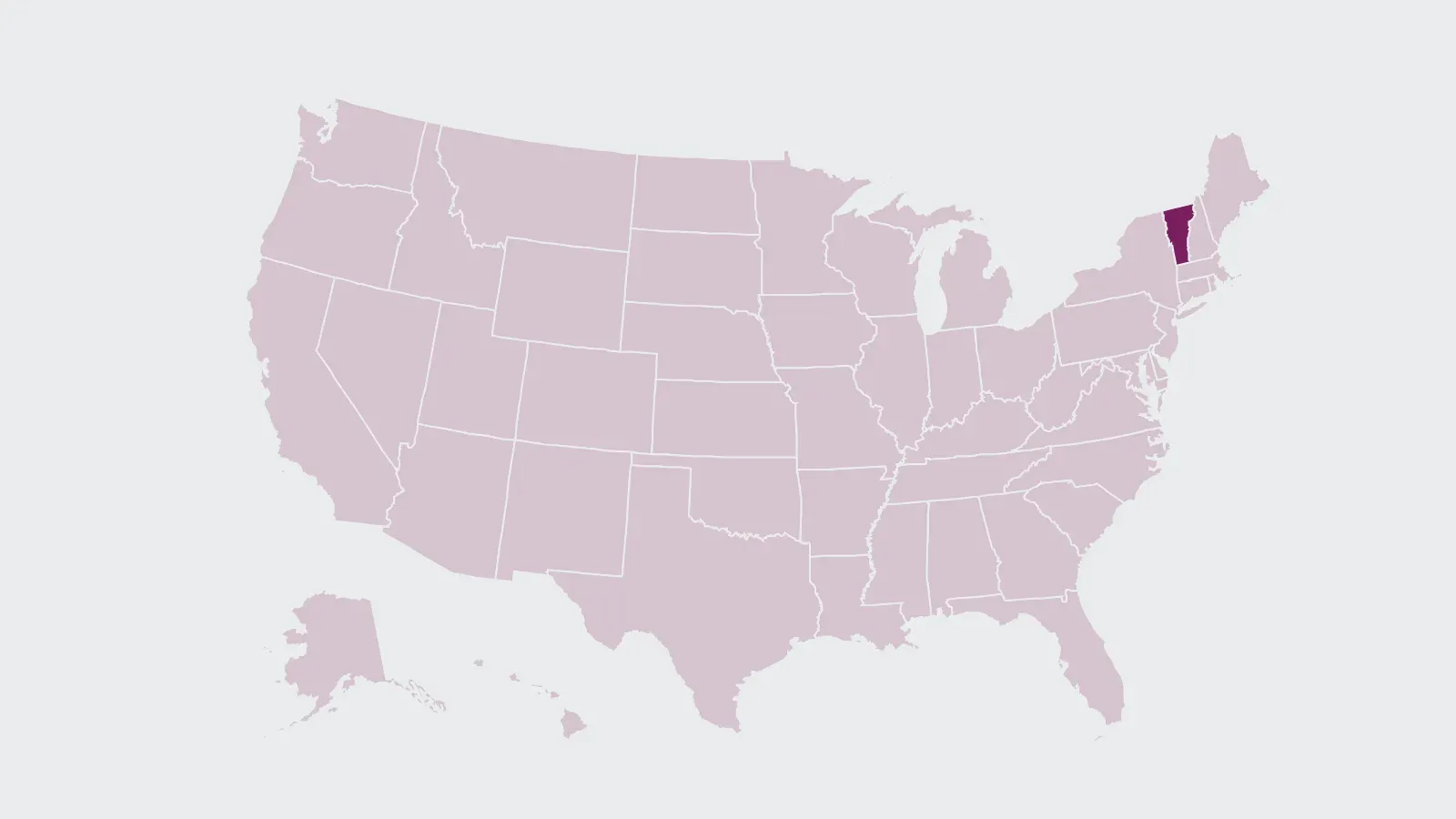
Price tier on the map
Under $1,000 a year
- Minimum liability limits
- 25/50/10
- Uninsured/underinsured motorist coverage required at 50/100 plus $10,000 property damage (23 V.S.A. § 941)
- Credit-based insurance scores
- Allowed, not as the only factor
- 8 V.S.A. § 4727: not the sole basis to deny, cancel, nonrenew or set a renewal rate; re-rating on request
- Regulator
- Vermont Department of Financial Regulation
Vermont's premium, coverage by coverage
Each year the National Association of Insurance Commissioners (NAIC) reports what insurers collected in every state. Its newest state figures, for 2023, show an average Vermont expenditure of $893 per insured car, up 13% from $793 in 2022. That average mixes liability-only cars with fully insured ones. For a car carrying all three main coverages, the combined premium was $958.
| Coverage | Vermont | United States |
|---|---|---|
| Liability | $381 | $737 |
| Collision | $385 | $464 |
| Comprehensive | $191 | $238 |
| All three (combined premium) | $958 | $1,438 |
| Average expenditure | $893 | $1,282 |
Liability, at $381, is about 48% below the U.S. figure, the widest gap of any line. Collision and comprehensive are also lower, by roughly 17% and 20%. One result: in Vermont the average collision premium ($385) is slightly higher than the average liability premium, the reverse of the national pattern. If you drive a newer car, the physical-damage part of the bill is likely where most of your money goes; our page on how the car itself affects the price explains why.
The coverage Vermont law requires
Under 23 V.S.A. § 800, you may not drive in Vermont without liability insurance of at least $25,000 for one person, $50,000 for two or more people and $10,000 for property damage in one crash. You must carry proof of coverage while driving, and a violation can bring a civil penalty of up to $500.
- Uninsured/underinsured motorist coverage is mandatory on every Vermont auto policy, at no less than $50,000 per person and $100,000 for two or more people injured, plus $10,000 for property damage subject to a $150 deductible.
- If you buy liability above the minimum, your uninsured motorist limits must match it unless you direct otherwise, so raising one usually raises the other.
- Medical payments, collision and comprehensive are optional under state law. A lender will normally require collision and comprehensive on a financed car.
A 25/50/10 policy pays at most $10,000 for the other driver's car, which may not cover a newer vehicle. Our guide to limits and deductibles shows what a step up in limits involves.
Credit and pricing in Vermont
The Department of Financial Regulation's consumer guide to auto insurance says each company sets its own premiums by making its own judgments about a set of risk categories. Because companies weigh those categories differently, quotes for the same driver can differ from one insurer to the next.
The guide also notes that credit history has become a rating element for most companies, which turn it into an insurance score. An insurer that uses it must describe the elements of the credit history it relies on. The department advises checking your credit report once a year. State law, 8 V.S.A. § 4727, sets the limits: an insurer can't deny, cancel or nonrenew a policy, or set a renewal rate, solely on credit; it must re-rate you on a current report if you ask at your annual renewal; an adverse action notice must give up to four main reasons; and you can ask for an exception if events such as a declared catastrophe or identity theft hurt your credit. Read more about credit-based insurance scores.
Turned down? The Vermont plan
A driver no company will insure can apply to the Vermont Automobile Insurance Plan, which the department calls the assigned risk plan. Prices there are generally higher than in the regular market, so it makes sense to shop again once your record is cleaner. See our guide to assigned risk plans.
Ways to cut a Vermont premium
- Get quotes on identical coverage. Because each company weighs risk differently, two or three quotes on the same limits and deductibles show you the spread.
- Ask about the discounts the department mentions: buying home and auto from one company, driver training or good student credits for young drivers with a B average or better, regular carpooling, airbags, automatic seat belts and anti-lock brakes. Amounts vary by company.
- Weigh a higher deductible. The deductible break-even calculator shows how many claim-free years it takes for the lower premium to pay for the extra risk.
- Call the Insurance Division if a company treats you unfairly. File a complaint online or by mail, or call 800-964-1784 (802-828-3302 for insurance consumers) for help.
Questions drivers ask
Is car insurance cheap in Vermont?
Compared with the U.S. average, yes. NAIC figures for 2023 put Vermont's average expenditure at $893 per insured car against $1,282 nationally, and the full-coverage combined premium at $958 against $1,438.
What is Vermont's minimum car insurance?
Liability of $25,000 per person, $50,000 per accident and $10,000 for property damage (25/50/10), plus uninsured/underinsured motorist coverage of at least $50,000/$100,000 and $10,000 for property damage.
Why is uninsured motorist coverage in Vermont higher than the liability minimum?
Vermont law sets the uninsured/underinsured motorist floor at $50,000 per person and $100,000 for two or more people, twice the liability minimums, so the coverage that protects you starts higher than the coverage that protects others.
Where can I get help with a Vermont auto insurance problem?
Contact the insurer first, then the Department of Financial Regulation's Insurance Division: online complaint form, 800-964-1784, or dfr.insuranceinfo@vermont.gov.
Where the figures come from
- NAIC — Auto Insurance Database Report 2022/2023 (state average premiums and expenditures)
- 8 V.S.A. § 4727 — Personal insurance; use of credit information (Vermont General Assembly)
- Vermont Department of Financial Regulation — Consumer's guide to auto insurance (revised May 2019)
- Vermont Department of Financial Regulation — Insurance complaints
- 23 V.S.A. § 800 — Maintenance of financial responsibility
- 23 V.S.A. § 941 — Uninsured, underinsured motorist coverage
- Insurance Information Institute — Uninsured motorists (Insurance Research Council estimates)
Facts on this page were checked against these sources on October 26, 2026. NAIC averages are for 2023, the latest year the NAIC has published by state.
Have your rate shopped
Averages can't price your car and your record. Tell us the basics of your policy and Guardbrook passes them to licensed insurance agents and insurers who can quote it; you decide whether to switch.
- 1 Your cars, drivers and current policy.
- 2 How agents can reach you, and your consent.
- 3 A licensed insurance agent or insurer contacts you with quotes. Your policy stays as it is until you decide to switch.
Guardbrook is not an insurance company or agency and doesn't sell, quote or bind policies. You pay Guardbrook nothing; the licensed insurance agents and insurers who contact you set their own prices and terms. How we make money.
Read next
-
Price factor
Claims history
A CLUE report shows up to 7 years of auto claims. Get a free copy every 12 months and fix errors before you shop.
-
Way to save
Raising your deductible
$500 to $1,000 can save $150 a year in our example and needs about 3.3 claim-free years to pay off.
-
Shopping guide
When to shop for car insurance
Renewal notices (45 days ahead in Maryland), moves, new cars and drivers, and old tickets that stop counting.