$1,250–$1,499 tier
What car insurance costs in Michigan
Michigan's 2023 average bill against the nation's, the no-fault choices that change it, and the rules that limit how insurers price you.
By Guardbrook Editorial Team Updated 7 min read
At a glance
- Average yearly spend, 2023
- $1,443
- Change from 2022
- +8%
- Minimum liability limits
- 50/100 (250/500 default)
- Uninsured drivers, 2023
- 22.3%
Bottom line
Michigan drivers spent an average of $1,443 per insured car in 2023, about 13% above the U.S. average, and a car with all three main coverages averaged $1,572. Every policy is no-fault: you pick a PIP medical level, and bodily injury liability starts at 250/500 unless you choose a lower option, down to 50/100. Insurers can't use your credit score, and rates must be approved before use, so the biggest levers left to you are the coverage choices and comparing companies.
The Michigan bill, line by line
Guardbrook
Average car insurance bill, 2023
Michigan
Liability$765
Collision$570
Comprehensive$237
Full coverage$1,572
Average spend per car$1,443
Compared with the U.S.+13%
Uninsured drivers22.3%
Average yearly premiums per insured car (NAIC); uninsured share: Insurance Research Council estimate. Averages, not a quote. Where these numbers come from
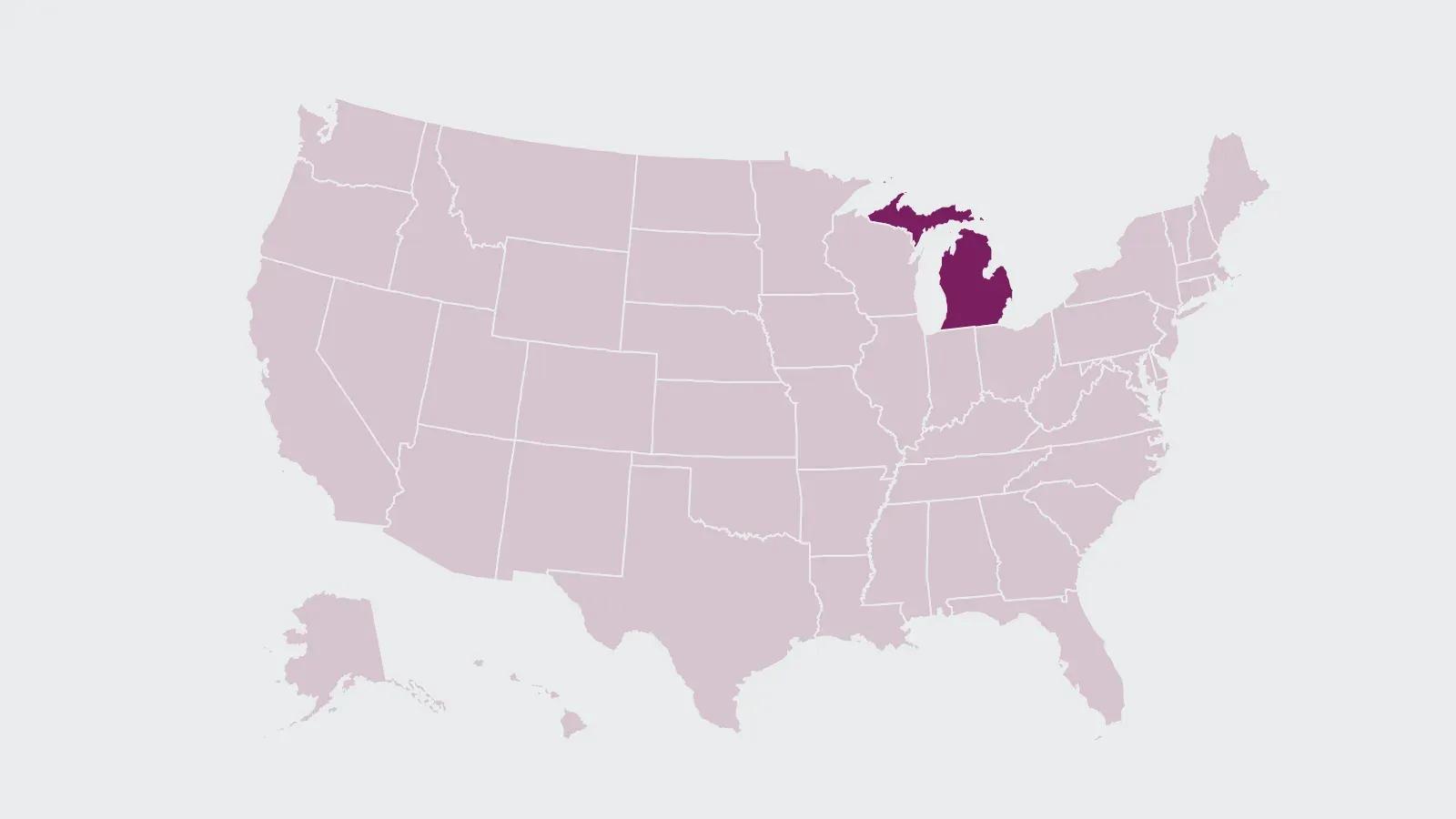
Price tier on the map
$1,250 to $1,499 a year
- Minimum liability limits
- 250/500 bodily injury by default; 50/100 lowest option
- No-fault: PIP medical level of your choice, $1 million property protection, $10,000 out-of-state property damage
- Credit-based insurance scores
- Credit score barred from rates
- MCL 500.2162
- Regulator
- Michigan Department of Insurance and Financial Services
Michigan's bill compared with the U.S.
The National Association of Insurance Commissioners (NAIC) publishes what insurers actually collected per insured car. Its 2023 state figures, the latest available, put Michigan's average expenditure at $1,443, up 8% from $1,340 in 2022. That increase was smaller than the 14% national rise, but Michigan still started and finished above the U.S. average.
| Coverage | Michigan | United States |
|---|---|---|
| Liability | $765 | $737 |
| Collision | $570 | $464 |
| Comprehensive | $237 | $238 |
| All three (combined premium) | $1,572 | $1,438 |
| Average expenditure | $1,443 | $1,282 |
Collision is where Michigan differs most: $570, roughly 23% above the national figure. Comprehensive is level with the U.S., and liability is about 4% higher. If you drive a financed car that must carry collision, that line deserves the closest look when you compare offers. Your own price still depends on your car, record and the coverage levels below.
What every Michigan policy carries
State law requires no-fault auto insurance to drive legally. Since the 2019 reform, which applies to policies issued or renewed after July 1, 2020, several parts of that package come with choices. The Department of Insurance and Financial Services (DIFS) describes three required pieces:
- Bodily injury and property damage liability. The default is $250,000 per person, $500,000 per accident and $10,000 for property damage in another state. You may choose lower limits, but not below $50,000 per person and $100,000 per accident; your insurer or agent must give you a form describing the benefits and risks.
- Personal injury protection (PIP) medical. Levels are unlimited (the default if you don't choose), up to $500,000, up to $250,000, up to $250,000 with exclusions for people whose health coverage pays for auto injuries, up to $50,000 if the named insured is on Medicaid, or an opt-out if the named insured has Medicare Parts A and B.
- Property protection insurance. It pays up to $1 million for damage your car does in Michigan to other people's property, such as buildings and fences.
Damage to another person's car is handled differently. Under the mini-tort rule, if you are 50% or more at fault you can be sued for up to $3,000 of the damage you caused. A lower PIP level or lower liability limits will cut the premium, but they shift risk to you; weigh them with our page on coverage limits and deductibles and check what your health plan actually covers before you choose.
Rules on how Michigan insurers price you
DIFS says auto insurance rates and policies must be filed with and approved by the department before they are offered to consumers. The 2019 reform also requires insurers to reduce statewide average PIP medical rates for eight years.
The same law bars several non-driving factors. Insurers can't use sex, marital status, home ownership, credit score, educational level, occupation or ZIP codes in setting a driver's rates. Section 500.2162 of the Michigan Insurance Code states it plainly: an insurer shall not use an individual's credit score to establish or maintain rates or rating classifications. See our page on credit-based insurance scores for how other states treat credit.
If insurers won't sell you a policy
Every company writing auto insurance in Michigan must take part in the Michigan Automobile Insurance Placement Facility, created by MCL 500.3301. Its job is to make coverage available to anyone who is unable to get it through ordinary methods, while encouraging drivers to use the regular market. A licensed agent can tell you how to apply; our guide to assigned risk plans explains what to expect from this kind of coverage.
Ways to bring a Michigan premium down
- Compare the same PIP level and limits across companies. Approval doesn't make prices uniform: quotes for identical choices can still differ from one company to the next.
- Revisit your PIP choice when your health coverage changes. The lower levels and the opt-out depend on Medicaid, Medicare or qualifying health insurance for you and your household.
- Trim extras you don't need. Our guide to trimming optional coverages shows which add-ons are safe to drop and which are not.
- Call DIFS with questions or a complaint. The auto insurance line is 833-ASK-DIFS (275-3437), Monday to Friday, 8 a.m. to 5 p.m. Eastern. DIFS asks you to try the insurer or agent first, then file online.
Questions drivers ask
What are the minimum car insurance limits in Michigan?
Bodily injury liability defaults to $250,000 per person and $500,000 per accident; you can choose lower limits down to $50,000 and $100,000. Policies also include $10,000 for property damage in another state, property protection insurance up to $1 million in Michigan, and PIP.
Can a Michigan insurer use my credit score to set my rate?
No. MCL 500.2162 bars insurers from using an individual's credit score to establish or maintain auto rates or rating classifications.
Does choosing a lower PIP level lower my premium?
It reduces the PIP medical part of the bill, but some levels require Medicaid, Medicare or health insurance that covers auto injuries. If you don't choose a level, the default is unlimited PIP medical coverage.
Is car insurance more expensive in Michigan than the national average?
Yes. NAIC data for 2023 put Michigan's average expenditure at $1,443 per insured car against $1,282 nationally, and the combined full-coverage premium at $1,572 against $1,438.
Where the figures come from
- NAIC — Auto Insurance Database Report 2022/2023 (state average premiums and expenditures)
- Michigan DIFS — Choosing bodily injury coverage
- Michigan DIFS — Choosing PIP medical coverage
- Michigan DIFS — Auto insurance frequently asked questions
- Michigan DIFS — Consumer protections in the auto insurance law
- Michigan Compiled Laws 500.2162 — Credit score not used for auto rates
- Michigan Compiled Laws 500.3301 — Michigan Automobile Insurance Placement Facility
- Insurance Information Institute — Uninsured motorists (Insurance Research Council estimates)
Facts on this page were checked against these sources on October 26, 2026. NAIC averages are for 2023, the latest year the NAIC has published by state. PIP levels and liability defaults are as DIFS describes them for policies issued or renewed after July 1, 2020.
Have your rate shopped
Averages can't price your car and your record. Tell us the basics of your policy and Guardbrook passes them to licensed insurance agents and insurers who can quote it; you decide whether to switch.
- 1 Your cars, drivers and current policy.
- 2 How agents can reach you, and your consent.
- 3 A licensed insurance agent or insurer contacts you with quotes. Your policy stays as it is until you decide to switch.
Guardbrook is not an insurance company or agency and doesn't sell, quote or bind policies. You pay Guardbrook nothing; the licensed insurance agents and insurers who contact you set their own prices and terms. How we make money.
Read next
-
Price factor
Coverage limits and deductibles
What 25/50/25 means, why liability is about half of a $1,438 full-coverage bill, and how to size a deductible.
-
Way to save
Trimming optional coverages
Rental, roadside, gap, custom equipment and MedPay: what each pays, when to drop it, and what to keep.
-
Shopping guide
Complaining about a rate increase
Ask the insurer, use your adverse action rights, read the filing, then complain; Maryland gives you 30 days.