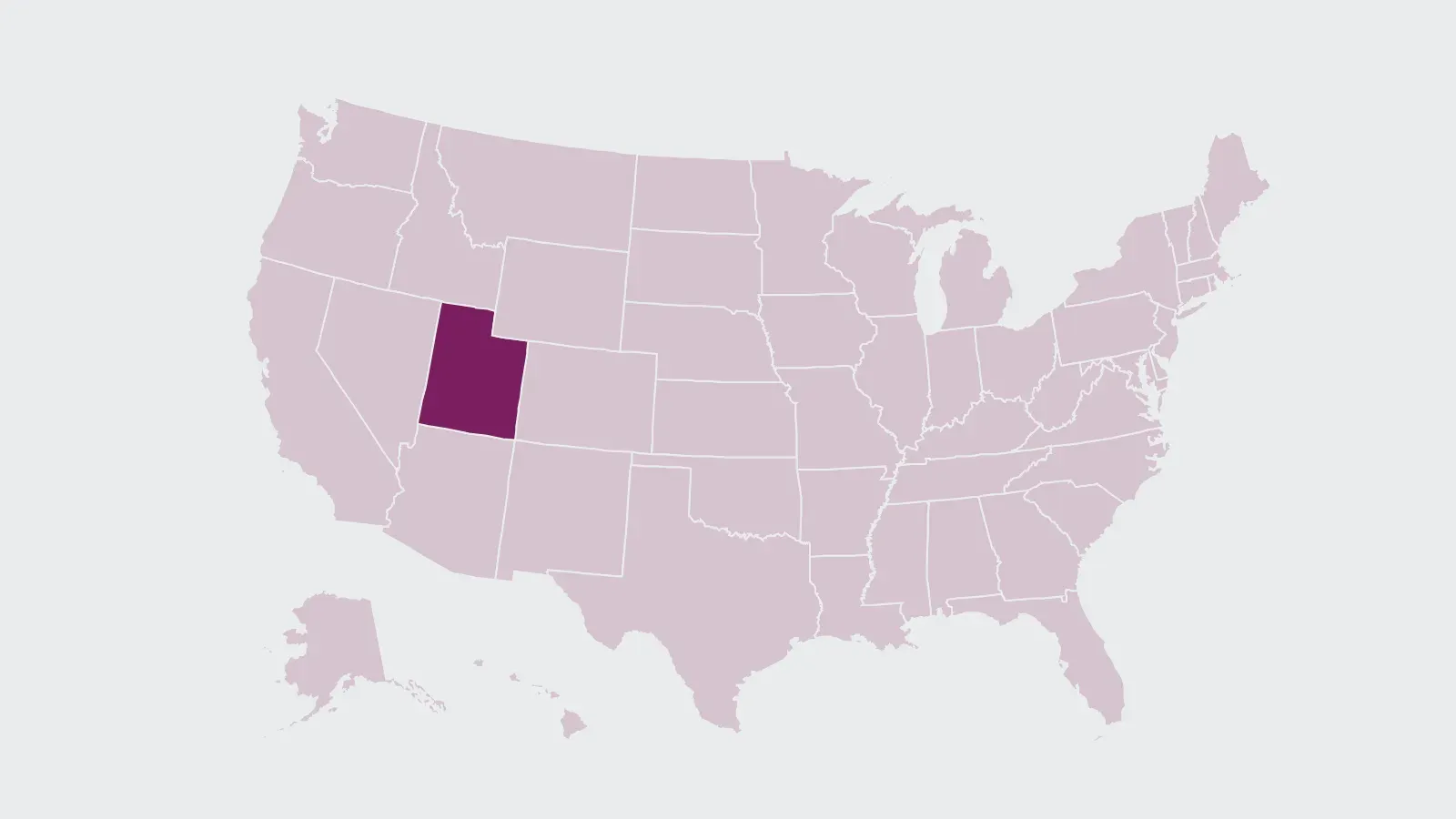
$1,000–$1,249 tier
What car insurance costs in Utah
The average Utah premium next to the national one, the no-fault coverage every policy carries, and the state's own price comparison.
By Guardbrook Editorial Team Updated 6 min read
At a glance
- Average yearly spend, 2023
- $1,169
- Change from 2022
- +14%
- Minimum liability limits
- 30/65/25
- Uninsured drivers, 2023
- 6.2%
Bottom line
Utah drivers spent an average of $1,169 per insured car in 2023, about 9% below the U.S. average of $1,282, and a car with all three main coverages averaged $1,285. Since January 1, 2025, the minimum liability is 30/65/25, and every policy also carries at least $3,000 of personal injury protection. Utah law bars insurers from using credit to set rates except to give a discount, and the Insurance Department publishes yearly sample premiums by company.
The Utah bill, line by line
Guardbrook
Average car insurance bill, 2023
Utah
Liability$746
Collision$378
Comprehensive$160
Full coverage$1,285
Average spend per car$1,169
Compared with the U.S.−9%
Uninsured drivers6.2%
Average yearly premiums per insured car (NAIC); uninsured share: Insurance Research Council estimate. Averages, not a quote. Where these numbers come from
Price tier on the map
$1,000 to $1,249 a year
- Minimum liability limits
- 30/65/25
- Since Jan. 1, 2025; no-fault state with $3,000 PIP; UM/UIM included unless waived in writing
- Credit-based insurance scores
- Only to lower a rate or give a discount
- Utah Code § 31A-22-320; also allowed in initial underwriting with other risk factors
- Regulator
- Utah Insurance Department
Utah's bill against the national average
The National Association of Insurance Commissioners (NAIC) gathers what insurers collected in each state. For 2023, the latest year it has published by state, the average Utah expenditure was $1,169 per insured car, 14% more than the $1,024 of 2022. That number averages liability-only cars with fully covered ones; a car carrying liability, collision and comprehensive had a combined premium of $1,285.
| Coverage | Utah | United States |
|---|---|---|
| Liability | $746 | $737 |
| Collision | $378 | $464 |
| Comprehensive | $160 | $238 |
| All three (combined premium) | $1,285 | $1,438 |
| Average expenditure | $1,169 | $1,282 |
The split is unusual. Liability, at $746, is about level with the U.S. figure. The coverages that repair your own car are well below it: collision is about 19% lower and comprehensive about a third lower. So the state's discount against the national average comes from physical damage, not from the liability side of the bill. Your own premium still depends on your car, record and ZIP code; see how location sets a price.
What every Utah policy must include
For policies issued or renewed on or after January 1, 2025, Utah's minimum liability limits are $30,000 for one injured person, $65,000 for two or more and $25,000 for property damage, or a $90,000 single limit. Before 2025 the floor was 25/65/15.
- Personal injury protection (PIP) is required. It must pay at least $3,000 per person in medical expenses, plus limited lost-income, funeral and survivor benefits.
- Utah limits injury lawsuits. You can sue the at-fault driver for general damages, such as pain and suffering, only after a death, dismemberment, a bone fracture, permanent disability or disfigurement, or more than $3,000 in medical expenses.
- Uninsured and underinsured motorist coverage are included by default at your liability limits. You can reject them or buy less, but only by signing the insurer's acknowledgment form or rejecting in writing.
At an estimated 6.2% in 2023, Utah had one of the lowest shares of uninsured drivers in the country, according to the Insurance Research Council. That doesn't make underinsured motorist coverage pointless: many insured drivers carry only the minimum. Our page on limits and deductibles helps you size it.
How Utah regulates rates and credit
Utah uses a use-and-file system: insurers must file rates and changes with the Insurance Department within 30 days after they take effect, rather than waiting for approval first.
Credit is tightly limited. Under Utah Code § 31A-22-320, an insurer writing auto coverage may not use credit information to decide renewal, nonrenewal, termination, eligibility or rating. It may use credit only in initial underwriting alongside other risk factors, or to give you a lower rate or a discount. More on credit-based insurance scores.
If you can't find a Utah insurer
Drivers turned down in the regular market can be placed through Utah's automobile insurance plan, one of the state plans run through AIPSO. An agent handles the application, and prices are usually higher, so plan to move back to a standard insurer as your record improves. The guide to assigned risk plans covers the details.
Ways to lower a Utah premium
- Start with the state's comparison tables. The Utah Insurance Department's annual tables list sample six-month premiums from the top 20 auto insurers in several ZIP codes, plus each company's complaint ratio. They use a standard profile, so treat them as a baseline before you get your own quotes.
- Ask about the discounts the department lists: multiple vehicles, driver education, good student, safety and anti-theft devices, low mileage, good driver, and auto-and-home packages. Each company sets its own amounts.
- Ask about a credit-based discount. In Utah, credit may earn you a lower rate but may not otherwise be used to rate your policy, so ask each company whether it offers such a reduction.
- Complain if something is wrong. The department's online complaint portal is the fastest route; call 801-957-9200 or 1-800-439-3805 in Utah, weekdays 8 a.m. to 5 p.m.
Questions drivers ask
How much is car insurance in Utah compared with the U.S.?
NAIC data for 2023 put the average Utah expenditure at $1,169 per insured car against $1,282 nationally. A car with liability, collision and comprehensive averaged $1,285 against $1,438.
What are Utah's minimum car insurance limits?
For policies issued or renewed on or after January 1, 2025: $30,000 per person and $65,000 per accident for injuries, $25,000 for property damage (30/65/25), plus at least $3,000 of PIP.
Is Utah a no-fault state?
Yes. Every policy carries personal injury protection, and you can sue the other driver for pain and suffering only after a serious injury, such as a fracture or permanent disability, or more than $3,000 in medical expenses.
Can a Utah insurer raise my rate because of my credit?
No. Utah Code § 31A-22-320 bars insurers from using credit for rating, renewal or cancellation; credit may lower a rate or earn a discount. See credit-based insurance scores.
Where the figures come from
- NAIC — Auto Insurance Database Report 2022/2023 (state average premiums and expenditures)
- Utah Insurance Department — Auto insurance
- Utah Insurance Department — 2025 annual comparison tables
- Utah Insurance Department — Complaints
- Utah Code § 31A-22-304 — Motor vehicle liability policy minimum limits (Justia)
- Utah Code § 31A-22-307 and § 31A-22-309 — Personal injury protection and limits on lawsuits (Justia)
- Utah Code § 31A-22-320 — Use of credit information (Justia)
- Utah Code § 31A-19a-203 — Rate filing (Justia)
- Insurance Information Institute — Uninsured motorists (Insurance Research Council estimates)
Facts on this page were checked against these sources on October 26, 2026. NAIC averages are for 2023, the latest year the NAIC has published by state.
Have your rate shopped
Averages can't price your car and your record. Tell us the basics of your policy and Guardbrook passes them to licensed insurance agents and insurers who can quote it; you decide whether to switch.
- 1 Your cars, drivers and current policy.
- 2 How agents can reach you, and your consent.
- 3 A licensed insurance agent or insurer contacts you with quotes. Your policy stays as it is until you decide to switch.
Guardbrook is not an insurance company or agency and doesn't sell, quote or bind policies. You pay Guardbrook nothing; the licensed insurance agents and insurers who contact you set their own prices and terms. How we make money.
Read next
-
Price factor
Credit-based insurance scores
Allowed in most states, barred from auto rates in CA, HI, MA and MI. Your rights when credit raises the price.
-
Shopping guide
Comparing quotes line by line
Match limits, deductibles and add-ons, list every driver, compare totals with fees, then check the company.
-
Way to save
Telematics and usage-based insurance
What tracking apps and plug-ins record, whether your price can rise, and 5 privacy questions to ask first.