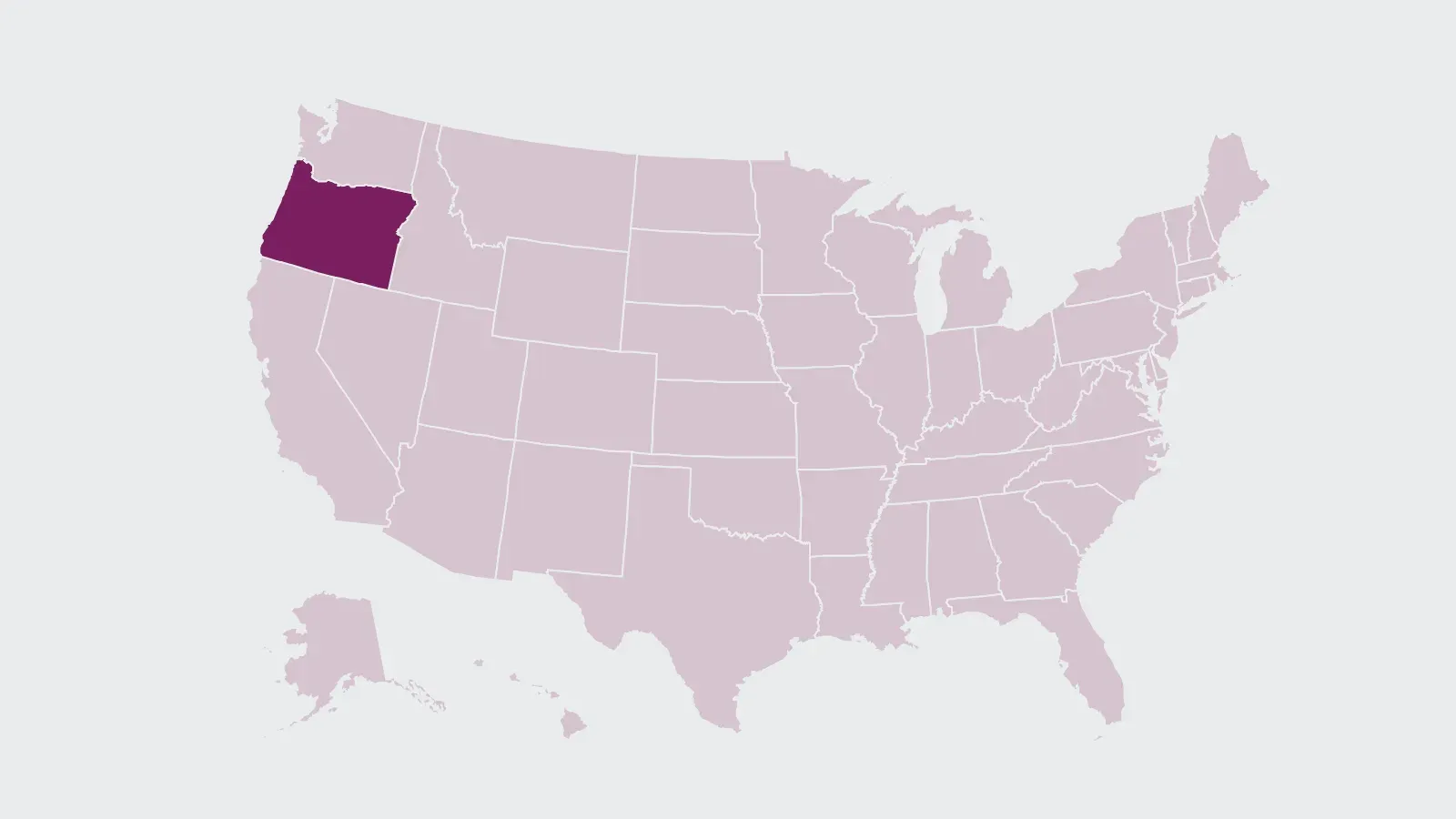
$1,000–$1,249 tier
What car insurance costs in Oregon
The average Oregon premium beside the U.S. one, the coverages Oregon puts on every policy, and the rules that can work in your favor.
By Guardbrook Editorial Team Updated 6 min read
At a glance
- Average yearly spend, 2023
- $1,170
- Change from 2022
- +16%
- Minimum liability limits
- 25/50/20
- Uninsured drivers, 2023
- 14.7%
Bottom line
Oregon drivers spent an average of $1,170 per insured car in 2023, about 9% below the U.S. average of $1,282, after a 16% jump from 2022. A car with all three main coverages averaged $1,268. Every Oregon policy needs 25/50/20 liability, $15,000 of personal injury protection and 25/50 uninsured motorist coverage. State law also limits how insurers use your credit once a policy is in force.
The Oregon bill, line by line
Guardbrook
Average car insurance bill, 2023
Oregon
Liability$751
Collision$352
Comprehensive$165
Full coverage$1,268
Average spend per car$1,170
Compared with the U.S.−9%
Uninsured drivers14.7%
Average yearly premiums per insured car (NAIC); uninsured share: Insurance Research Council estimate. Averages, not a quote. Where these numbers come from
Price tier on the map
$1,000 to $1,249 a year
- Minimum liability limits
- 25/50/20
- Plus $15,000 PIP per person and 25/50 uninsured motorist coverage (Oregon DMV)
- Credit-based insurance scores
- Allowed, not to re-rate at renewal
- ORS 746.661: no cancellation or nonrenewal over credit after 60 days; renewal re-rates use other factors
- Regulator
- Oregon Division of Financial Regulation
How Oregon's bill compares
The National Association of Insurance Commissioners (NAIC) tracks what insurers collect for each insured car. Its newest state data, for 2023, show an Oregon average expenditure of $1,170, up 16% from $1,006 in 2022, while the U.S. average rose 14%. The expenditure counts liability-only cars and fully covered cars together. With liability, collision and comprehensive on the same car, the combined premium was $1,268.
| Coverage | Oregon | United States |
|---|---|---|
| Liability | $751 | $737 |
| Collision | $352 | $464 |
| Comprehensive | $165 | $238 |
| All three (combined premium) | $1,268 | $1,438 |
| Average expenditure | $1,170 | $1,282 |
Liability is the one line above the national figure, by $14. Collision and comprehensive, the coverages that pay for your own car, were well below it: $112 and $73 under. So in Oregon the required part of the bill weighs more, and the optional part less, than in the country as a whole. That matters when you decide which costs you can actually move; see trimming optional coverages.
What every Oregon policy must include
Oregon's minimum liability is $25,000 per person and $50,000 per crash for injuries to others, plus $20,000 per crash for damage to others' property, written as 25/50/20. Oregon DMV lists two more coverages that every policy must carry, and you give your policy number each time you register a vehicle.
- Personal injury protection (PIP), $15,000 per person. According to the Division of Financial Regulation, PIP pays reasonable and necessary medical expenses incurred within two years of the crash, up to your PIP limit, and your health insurance usually won't pay accident bills until PIP is used up.
- Uninsured motorist coverage, $25,000 per person and $50,000 per crash for bodily injury. The Insurance Research Council estimates that 14.7% of Oregon drivers were uninsured in 2023.
- Collision and comprehensive are not required by the state, though a lender or leasing company will usually demand them.
Because PIP and uninsured motorist coverage are fixed parts of the policy, the main choices you control are your liability limits, your deductibles and the optional extras. Our guide to limits and deductibles shows how each one moves the price.
Oregon's limits on credit-based pricing
Oregon law (ORS 746.661) lets insurers consider credit history when you first apply, but it puts firm limits on what happens afterwards. An insurer may not cancel or refuse to renew a policy that has been in force more than 60 days because of your credit. At renewal, it may re-rate the policy only on factors other than credit history or an insurance score.
- Once a year per insurer and policy line, you can ask to be re-rated on the standards for a new applicant. Credit information from that review can't be used to raise your premium, and a better tier lowers it from the date you asked.
- An insurer can't re-rate you on credit because your marital status changed through the death of a spouse or a divorce.
- If you correct a credit report error through the federal Fair Credit Reporting Act process and tell the insurer in writing, it must re-rate back to the start of the current term.
The statute also bars counting insurance-related credit inquiries or your total available credit line against you. More background is on our page about credit-based insurance scores.
Driving record and the assigned risk pool
Oregon premiums reflect your driving record for the past three years, and insurers check records with Oregon DMV and other states. If no company will take you, you may qualify for the assigned risk pool: an agent can arrange coverage through the Western Association Automobile Insurance Plans, reachable at 800-227-4659. Our guide to assigned risk plans explains what to expect from one.
State law limits when an insurer can refuse to renew, and the company must give at least 10 days' notice before canceling for nonpayment and at least 30 days' notice, with a reason, for other cancellations or nonrenewals.
Where an Oregon driver can save
- Shop around. The Division of Financial Regulation notes that what coverage costs varies between companies. Ask two or three for quotes on identical limits and deductibles.
- Use your once-a-year re-rate. If your credit has improved, ask your insurer to re-rate you as a new applicant; under Oregon law the review can't raise your premium.
- Keep your record clean. Tickets and accidents follow you for three years in Oregon pricing, and many companies give discounts to drivers with clean records for three years or more.
- Contact the Division of Financial Regulation if you can't settle a problem with your insurer. Its consumer hotline is 888-877-4894, and complaints can be filed online.
Questions drivers ask
Is car insurance in Oregon more or less expensive than average?
Less, on NAIC's 2023 numbers: $1,170 per insured car against $1,282 for the U.S. Oregon's liability line was slightly higher than the national figure, while collision and comprehensive were lower.
Is PIP required in Oregon?
Yes. Oregon DMV lists personal injury protection of $15,000 per person among the minimum coverages, together with 25/50/20 liability and 25/50 uninsured motorist coverage.
Can my Oregon insurer raise my rate at renewal because of my credit?
No. Under ORS 746.661 an insurer may re-rate a policy at renewal only on factors other than credit, apart from a re-rate you request or a correction of disputed credit. See credit-based insurance scores.
What can I do if no insurer will cover me in Oregon?
Ask an agent to place you in the assigned risk pool through the Western Association Automobile Insurance Plans (800-227-4659), and shop again once tickets and accidents are more than three years old.
Where the figures come from
- NAIC — Auto Insurance Database Report 2022/2023 (state average premiums and expenditures)
- Oregon DMV — Insurance requirements
- Oregon Revised Statutes, chapter 806 (ORS 806.070 — minimum liability amounts)
- Oregon Division of Financial Regulation — Auto insurance
- Oregon Division of Financial Regulation — Auto insurance 101
- Oregon Division of Financial Regulation — Auto insurance FAQs (PIP)
- ORS 746.661 — Use of credit history or insurance score (text via Oregon Public Law)
- U.S. Bureau of Labor Statistics — CPI, table 2 (motor vehicle insurance)
- Insurance Information Institute — Uninsured motorists (Insurance Research Council estimates)
Facts on this page were checked against these sources on October 26, 2026. NAIC averages are for 2023, the latest year the NAIC has published by state.
Have your rate shopped
Averages can't price your car and your record. Tell us the basics of your policy and Guardbrook passes them to licensed insurance agents and insurers who can quote it; you decide whether to switch.
- 1 Your cars, drivers and current policy.
- 2 How agents can reach you, and your consent.
- 3 A licensed insurance agent or insurer contacts you with quotes. Your policy stays as it is until you decide to switch.
Guardbrook is not an insurance company or agency and doesn't sell, quote or bind policies. You pay Guardbrook nothing; the licensed insurance agents and insurers who contact you set their own prices and terms. How we make money.
Read next
-
Price factor
Credit-based insurance scores
Allowed in most states, barred from auto rates in CA, HI, MA and MI. Your rights when credit raises the price.
-

Way to save
Trimming optional coverages
Rental, roadside, gap, custom equipment and MedPay: what each pays, when to drop it, and what to keep.
-

Shopping guide
Why your premium went up
Market-wide changes vs. your own record. The price index fell 5.0% to September 2026; yours may not have.