$1,000–$1,249 tier
What car insurance costs in Minnesota
How the average Minnesota bill compares with the U.S., what no-fault law adds to every policy, and which state rules can lower your price.
By Guardbrook Editorial Team Updated 6 min read
At a glance
- Average yearly spend, 2023
- $1,103
- Change from 2022
- +15%
- Minimum liability limits
- 30/60/10
- Uninsured drivers, 2023
- 11.3%
Bottom line
Minnesota drivers spent an average of $1,103 per insured car in 2023, 14% less than the U.S. average, and a car with full coverage averaged $1,223. Every policy carries 30/60/10 liability, $40,000 of no-fault benefits and both uninsured and underinsured motorist coverage. Comprehensive is the one line above the national figure. Drivers 55 and older can earn a premium reduction for an accident prevention course.
The Minnesota bill, line by line
Guardbrook
Average car insurance bill, 2023
Minnesota
Liability$542
Collision$360
Comprehensive$321
Full coverage$1,223
Average spend per car$1,103
Compared with the U.S.−14%
Uninsured drivers11.3%
Average yearly premiums per insured car (NAIC); uninsured share: Insurance Research Council estimate. Averages, not a quote. Where these numbers come from
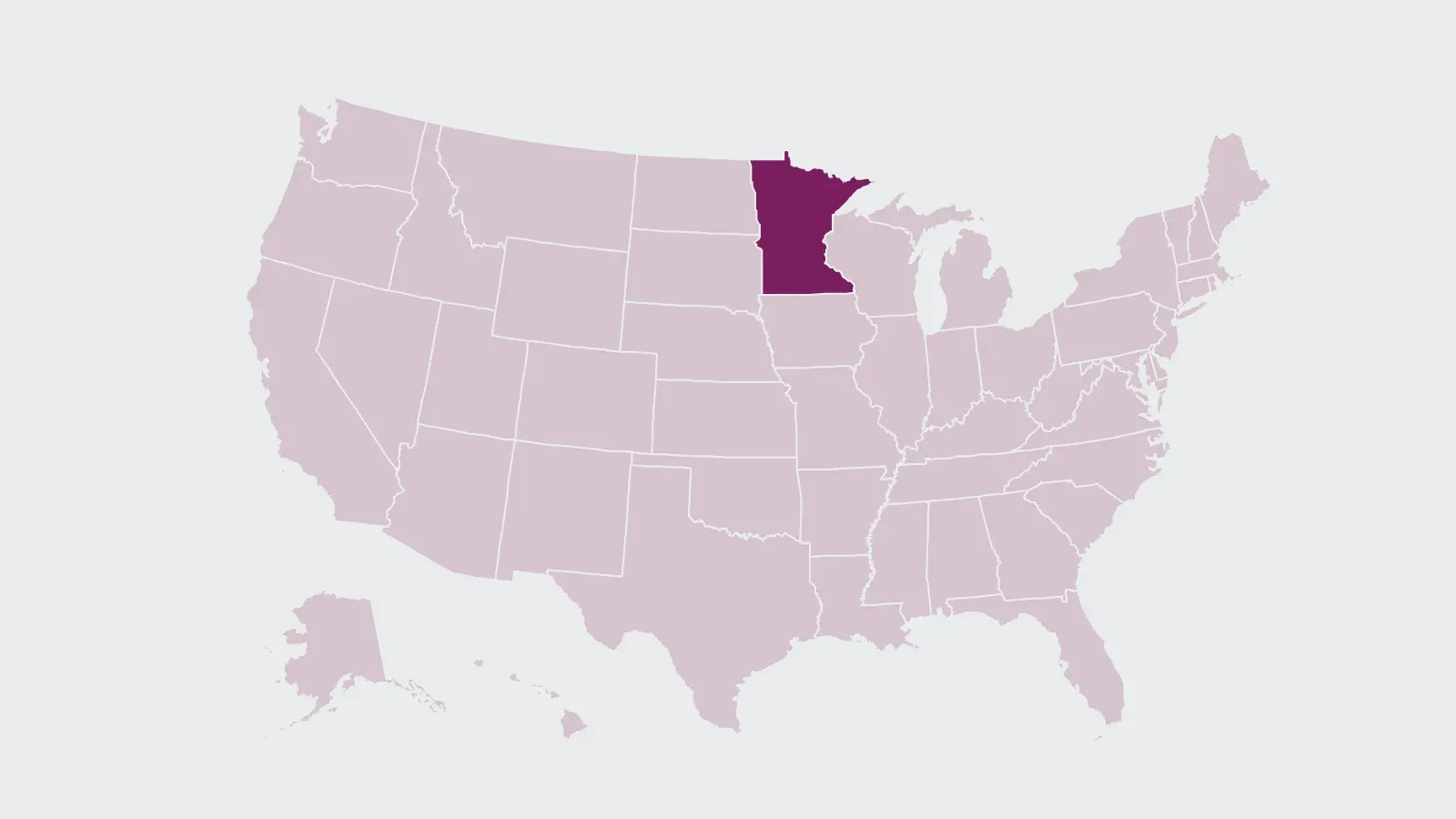
Price tier on the map
$1,000 to $1,249 a year
- Minimum liability limits
- 30/60/10
- No-fault: $40,000 PIP ($20,000 medical, $20,000 other); uninsured and underinsured motorist 25/50 each
- Credit-based insurance scores
- Allowed, with limits
- Minn. Stat. 72A.20, subd. 36: not without other factors; exceptions for illness, job loss, a death in the family
- Regulator
- Minnesota Department of Commerce
The Minnesota average against the national one
Each year the National Association of Insurance Commissioners (NAIC) reports what insurers collected per insured car in every state. For 2023, its latest state-level year, Minnesota's average expenditure was $1,103, up 15% from $962 in 2022, a rise close to the national one.
| Coverage | Minnesota | United States |
|---|---|---|
| Liability | $542 | $737 |
| Collision | $360 | $464 |
| Comprehensive | $321 | $238 |
| All three (combined premium) | $1,223 | $1,438 |
| Average expenditure | $1,103 | $1,282 |
Liability averaged about 26% less than the U.S. figure, and collision about 22% less. Comprehensive went the other way: at $321 it was roughly 35% above the national average, so it makes up a bigger share of a fully covered Minnesota car's bill than it does elsewhere. That makes the comprehensive deductible worth a look when you compare quotes.
Minnesota's no-fault requirements
Minnesota law requires auto insurance, and the minimums are set in the state's no-fault act. Each policy must include:
- Liability: at least $30,000 for injury to one person, $60,000 for injuries to two or more people and $10,000 for damage to others' property.
- No-fault (personal injury protection): at least $40,000 per person, split into $20,000 for medical expenses and $20,000 for income loss, replacement services, funeral costs and survivor's losses. It pays no matter who caused the crash.
- Uninsured and underinsured motorist coverage: both are required as separate coverages, each at least $25,000 per person and $50,000 per accident.
No-fault doesn't pay to fix your own car; that takes collision coverage. The Minnesota Department of Commerce also advises filing a no-fault claim within six months of an accident. Before trimming anything above the minimums, read our guide to limits and deductibles.
How rates and credit are regulated
Under Minnesota's rate law for casualty insurance, insurers must file their rates with the commissioner of commerce no later than the date they take effect; the law doesn't call for approval first. The commissioner may hold a hearing on an increase of 25% or more within 12 months. The Department of Commerce notes that how rates are determined varies by company, which is why shopping around matters.
Credit history can count. The Department lists it among the factors that affect premiums, and Minnesota Statutes section 72A.20, subdivision 36, sets limits. An insurer can't reject, cancel or refuse to renew a policy on credit without weighing other underwriting factors. If a catastrophic illness or injury, a temporary job loss or the death of an immediate family member hurt your credit, you can ask for a reasonable exception. You can also ask the insurer to re-check your score, up to twice a year, with any change applied at renewal. More on credit-based insurance scores.
A discount the law requires
Minnesota requires insurers to cut the premium for drivers 55 and older who complete an approved accident prevention course. The statute sets the reduction at no less than 10%. The first course and the refresher each run four hours, and you keep the discount by retaking a course every three years. Our page on the defensive driving course discount covers how to find a course and claim it.
Coverage when insurers say no
Insurers in the state form the Minnesota Automobile Insurance Plan, set up under chapter 65B of Minnesota Statutes to make auto insurance available to anyone unable to get it through ordinary methods. A licensed agent can explain how to apply. Our guide to assigned risk plans explains what this kind of coverage usually costs and how to move back to a regular policy.
- Get quotes on identical coverage. Match liability limits, no-fault, uninsured and underinsured motorist coverage and deductibles so the prices are comparable.
- Ask about the 55+ course reduction if anyone on the policy qualifies, and keep the certificate current.
- Call the Department of Commerce if you have a complaint: 651-539-1600 in the Twin Cities or 800-657-3602 in Greater Minnesota, or use the online complaint form.
Questions drivers ask
What car insurance does Minnesota require?
Liability of 30/60/10, no-fault benefits of at least $40,000 per person ($20,000 medical and $20,000 non-medical), and uninsured and underinsured motorist coverage of at least $25,000 per person and $50,000 per accident.
Is car insurance cheaper in Minnesota than the U.S. average?
Yes, on average. NAIC data for 2023 put Minnesota's average expenditure at $1,103 per insured car against $1,282 nationally, and full coverage at $1,223 against $1,438.
Do Minnesota drivers over 55 get a discount?
Yes, if they complete an approved accident prevention course. State law requires a reduction of at least 10%, renewed by retaking a course every three years. See course discounts.
Can a Minnesota insurer use my credit?
Yes, with limits. It can't refuse, cancel or non-renew on credit without other factors, and you can ask for an exception after a catastrophic illness or injury, a temporary job loss or a death in the immediate family.
Where the figures come from
- NAIC — Auto Insurance Database Report 2022/2023 (state average premiums and expenditures)
- Minnesota Department of Commerce — Auto insurance basics
- Minnesota Department of Commerce — Buying auto insurance
- Minnesota Department of Commerce — Auto insurance and consumer complaints
- Minnesota Statutes 65B.49 — Required liability, uninsured and underinsured motorist coverage
- Minnesota Statutes 65B.44 — Basic economic loss benefits
- Minnesota Statutes 65B.28 — Accident prevention course premium reductions
- Minnesota Statutes 72A.20 — Limitations on use of credit information (subd. 36)
- Minnesota Statutes 70A.06 — Rate filings
- Insurance Information Institute — Uninsured motorists (Insurance Research Council estimates)
Facts on this page were checked against these sources on October 26, 2026. NAIC averages are for 2023, the latest year the NAIC has published by state. Coverage minimums are taken from Minnesota Statutes sections 65B.44 and 65B.49.
Have your rate shopped
Averages can't price your car and your record. Tell us the basics of your policy and Guardbrook passes them to licensed insurance agents and insurers who can quote it; you decide whether to switch.
- 1 Your cars, drivers and current policy.
- 2 How agents can reach you, and your consent.
- 3 A licensed insurance agent or insurer contacts you with quotes. Your policy stays as it is until you decide to switch.
Guardbrook is not an insurance company or agency and doesn't sell, quote or bind policies. You pay Guardbrook nothing; the licensed insurance agents and insurers who contact you set their own prices and terms. How we make money.
Read next
-

Way to save
Defensive driving course discount
At least 10% in Minnesota for drivers 55+, 10% in Delaware at any age. State rules, how long it lasts, how to claim.
-

Price factor
Age and driving experience
Teens have almost 3x the fatal crash rate of drivers 20+; HI, MA and NC limit age rating. Course discounts from 55.
-

Shopping guide
Comparing quotes line by line
Match limits, deductibles and add-ons, list every driver, compare totals with fees, then check the company.