$1,500 or more tier
What car insurance costs in Georgia
How a typical Georgia premium breaks down, the coverages state law builds in, and the rules and discounts that can trim what you pay.
By Guardbrook Editorial Team Updated 7 min read
At a glance
- Average yearly spend, 2023
- $1,555
- Change from 2022
- +16%
- Minimum liability limits
- 25/50/25
- Uninsured drivers, 2023
- 19.0%
Bottom line
Georgians spent an average of $1,555 per insured car in 2023, 21% more than the U.S. average of $1,282, and a fully covered car averaged $1,746. Liability, at $1,046, accounts for most of the gap. The state requires 25/50/25 liability and adds uninsured motorist coverage unless you reject it in writing. New rates for minimum-limits policies need the Commissioner's approval or a 45-day review, and a qualifying student is owed a good-grades discount.
The Georgia bill, line by line
Guardbrook
Average car insurance bill, 2023
Georgia
Liability$1,046
Collision$473
Comprehensive$227
Full coverage$1,746
Average spend per car$1,555
Compared with the U.S.+21%
Uninsured drivers19.0%
Average yearly premiums per insured car (NAIC); uninsured share: Insurance Research Council estimate. Averages, not a quote. Where these numbers come from
Price tier on the map
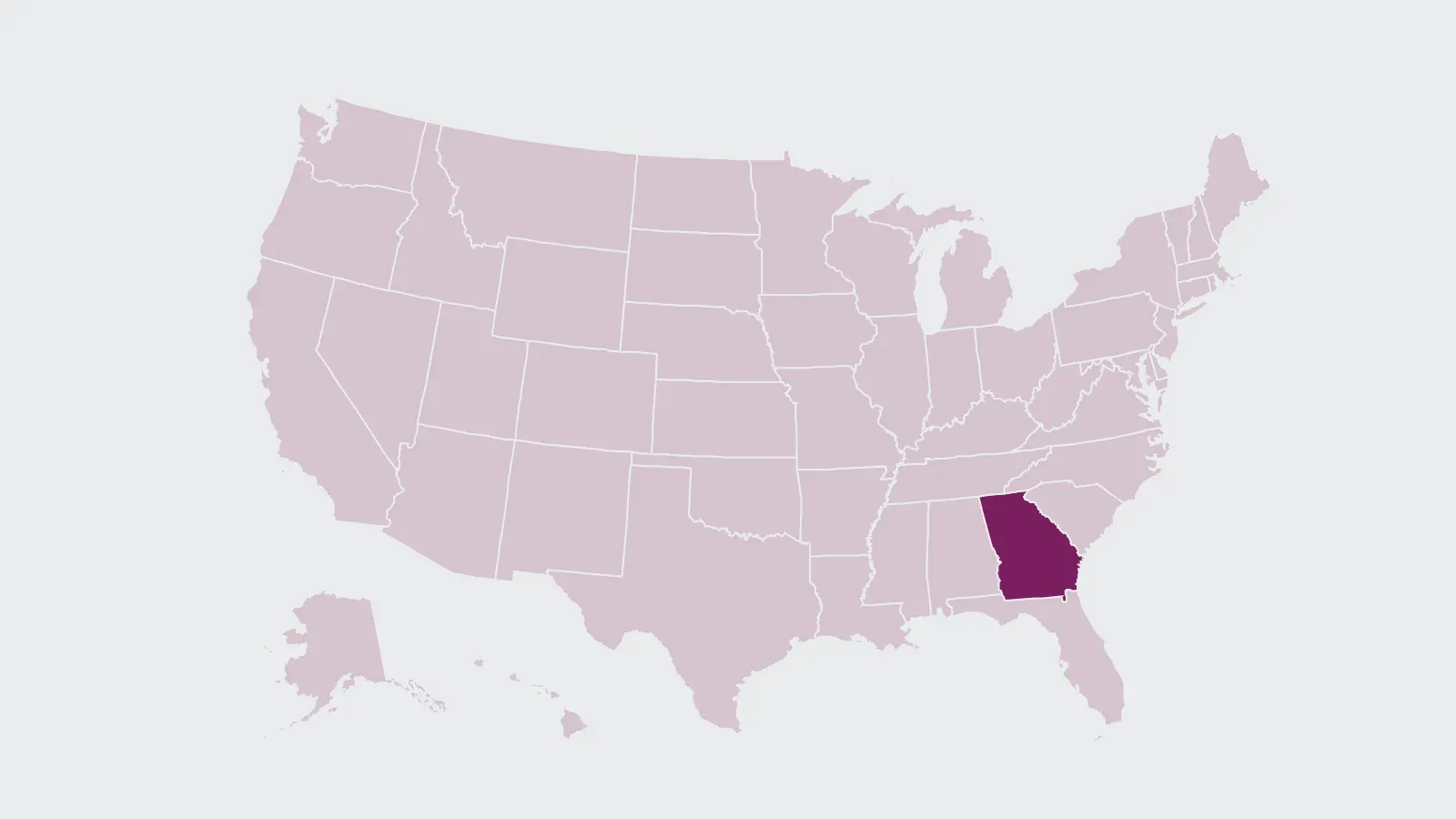
$1,500 or more a year
- Minimum liability limits
- 25/50/25
- Uninsured motorist coverage of at least 25/50/25 included unless rejected in writing
- Credit-based insurance scores
- Allowed, not as the only factor
- O.C.G.A. § 33-24-91
- Regulator
- Georgia Office of Commissioner of Insurance and Safety Fire
Where a Georgia premium goes
The National Association of Insurance Commissioners (NAIC) tallies what insurers charged per insured car in each state; its latest state year is 2023. Georgia's average expenditure that year was $1,555, up 16% from $1,345 in 2022, one of the steeper one-year increases in the table. That figure averages liability-only policies with full ones. With liability, collision and comprehensive together, the average was $1,746.
| Coverage | Georgia | United States |
|---|---|---|
| Liability | $1,046 | $737 |
| Collision | $473 | $464 |
| Comprehensive | $227 | $238 |
| All three (combined premium) | $1,746 | $1,438 |
| Average expenditure | $1,555 | $1,282 |
Liability is the line that pulls Georgia up: $1,046, about 42% more than the national $737. Collision is only slightly above the U.S. figure and comprehensive slightly below it. In other words, coverage for the damage you might do to others costs a Georgian far more than average, while coverage for your own car is priced close to the national norm. The NAIC data stop at the numbers; for the personal side of the price, see how credit-based scores are used and the other factors behind a quote.
The coverage Georgia builds in
The Georgia Office of Commissioner of Insurance and Safety Fire lists the liability minimums as $25,000 per person and $50,000 per incident for bodily injury and $25,000 for property damage, or 25/50/25. Georgia's uninsured motorist statute, O.C.G.A. § 33-7-11, then adds more:
- Uninsured motorist coverage comes with the policy at 25/50/25 or more unless a named insured rejects it in writing. You can choose limits up to your own liability limits.
- Added-on is the starting point. The standard version pays on top of the at-fault driver's liability coverage. A reduced-by version, which subtracts what that driver's insurer pays, applies only if you reject added-on coverage and pick it in writing.
- Collision and comprehensive aren't required by the state, but a lender or lessor will usually insist on them.
The Insurance Research Council estimates that 19.0% of Georgia drivers were uninsured in 2023, close to one in five. Before you drop or shrink uninsured motorist coverage to save money, weigh that number; our guide to limits and deductibles shows where cutting coverage makes sense and where it doesn't.
Two tracks for Georgia rate filings
Under O.C.G.A. § 33-9-21, how a rate gets approved depends on the policy. For personal auto policies with only the mandatory minimum limits, a new rate can't take effect until the Commissioner approves it or 45 days pass without a disapproval; the Commissioner can extend that by up to 55 days. For policies with higher limits or optional coverages, a filing takes effect 60 days after it is made, without approval, though an insurer may choose the prior-approval route instead.
Credit can play a part. O.C.G.A. § 33-24-91 doesn't let an insurer deny, cancel or nonrenew a personal policy, or set a renewal rate, solely on credit information; another underwriting factor has to be considered. A score can't be built from income, gender, race, address or ZIP code, among other traits.
The Commissioner's auto guide adds two protections worth knowing. After three years with the same company, you can't be nonrenewed because of a single claim, even one you caused. And if you want to contest a nonrenewal, you can send the Commissioner a written request for review within 15 days of the notice.
If no regular insurer will sell you a policy
The Georgia Automobile Insurance Plan, in place since 1949, covers drivers who can't get insurance in the voluntary market. Only an agent can apply for you, and any agent with a Georgia property and casualty license can place business through it. Non-standard insurers, which serve drivers with trouble getting regular coverage at higher premiums, are the other option. Our guide to assigned risk plans explains how to use either as a temporary step.
Ways to trim a Georgia premium
- Claim the good student discount. The Commissioner's guide says insurers must reduce liability, first-party medical and collision rates for students in the top 20% of their class, with a B or 3.0 average, or on the Dean's List or Honor Roll. More in our good student discount guide.
- Shop several companies at once. Ask for quotes on the same liability, uninsured motorist and deductible choices so the prices are comparable.
- Read the declarations page before you renew. It shows whether your uninsured motorist coverage is added-on or reduced-by, and what each line costs; our guide to reading your declarations page walks through it.
- Bring disputes to the Commissioner. Consumer Services answers at (404) 656-2070 or toll-free (800) 656-2298, weekdays 8 a.m. to 5 p.m. Eastern, and the office takes complaints online.
Questions drivers ask
How much more does car insurance cost in Georgia than nationally?
NAIC data for 2023 put Georgia's average expenditure at $1,555 per insured car, 21% above the U.S. average of $1,282. Full coverage averaged $1,746 against $1,438.
Is uninsured motorist coverage required in Georgia?
It is included in every policy at 25/50/25 or more unless a named insured rejects it in writing.
What is the difference between added-on and reduced-by coverage in Georgia?
Added-on uninsured motorist coverage pays on top of the at-fault driver's liability coverage; reduced-by subtracts what that coverage pays. Added-on is the standard choice unless you pick reduced-by in writing.
Can a Georgia insurer drop me after one claim?
Not if you have been with the company for three years: the Commissioner's guide says a single claim, even an at-fault one, can't be the reason for a nonrenewal after that point.
Where the figures come from
- NAIC — Auto Insurance Database Report 2022/2023 (state average premiums and expenditures)
- Georgia Office of Commissioner of Insurance and Safety Fire — Auto insurance
- Georgia Office of Commissioner of Insurance and Safety Fire — Guide for Automobile Insurance
- O.C.G.A. § 33-7-11 — Uninsured motorist coverage (Justia, 2025 Code of Georgia)
- O.C.G.A. § 33-9-21 — Rate filings (Justia, 2025 Code of Georgia)
- O.C.G.A. § 33-24-91 — Use of credit information (Onecle)
- AIPSO — Georgia Automobile Insurance Plan
- Insurance Information Institute — Uninsured motorists (Insurance Research Council estimates)
Facts on this page were checked against these sources on October 26, 2026. NAIC averages are for 2023, the latest year the NAIC has published by state.
Have your rate shopped
Averages can't price your car and your record. Tell us the basics of your policy and Guardbrook passes them to licensed insurance agents and insurers who can quote it; you decide whether to switch.
- 1 Your cars, drivers and current policy.
- 2 How agents can reach you, and your consent.
- 3 A licensed insurance agent or insurer contacts you with quotes. Your policy stays as it is until you decide to switch.
Guardbrook is not an insurance company or agency and doesn't sell, quote or bind policies. You pay Guardbrook nothing; the licensed insurance agents and insurers who contact you set their own prices and terms. How we make money.
Read next
-

Price factor
Credit-based insurance scores
Allowed in most states, barred from auto rates in CA, HI, MA and MI. Your rights when credit raises the price.
-

Way to save
Good student discount
Wisconsin's regulator says it typically runs 10% to 20% for a B average. Georgia requires one by law.
-

Shopping guide
Reading your declarations page
Drivers, cars, limits such as 50/100/50, deductibles, rejected coverages, required discounts and the premium.