$1,500 or more tier
What car insurance costs in Florida
Why Florida's average premium tops the national table, what the no-fault law requires, and which state rules can work in your favor.
By Guardbrook Editorial Team Updated 7 min read
At a glance
- Average yearly spend, 2023
- $1,864
- Change from 2022
- +19%
- Minimum liability limits
- $10k PIP + $10k PD
- Uninsured drivers, 2023
- 20.6%
Bottom line
Florida had the highest average car insurance expenditure in the NAIC's 2023 state table: $1,864 per insured car, 45% above the U.S. average of $1,282, and $1,994 for a car with full coverage. Nearly all of the gap is in the liability line; collision and comprehensive sit close to the national averages. The state requires $10,000 of personal injury protection and $10,000 of property damage liability, and drivers 55 and older can earn a discount for an approved accident prevention course.
The Florida bill, line by line
Guardbrook
Average car insurance bill, 2023
Florida
Liability$1,294
Collision$469
Comprehensive$230
Full coverage$1,994
Average spend per car$1,864
Compared with the U.S.+45%
Uninsured drivers20.6%
Average yearly premiums per insured car (NAIC); uninsured share: Insurance Research Council estimate. Averages, not a quote. Where these numbers come from
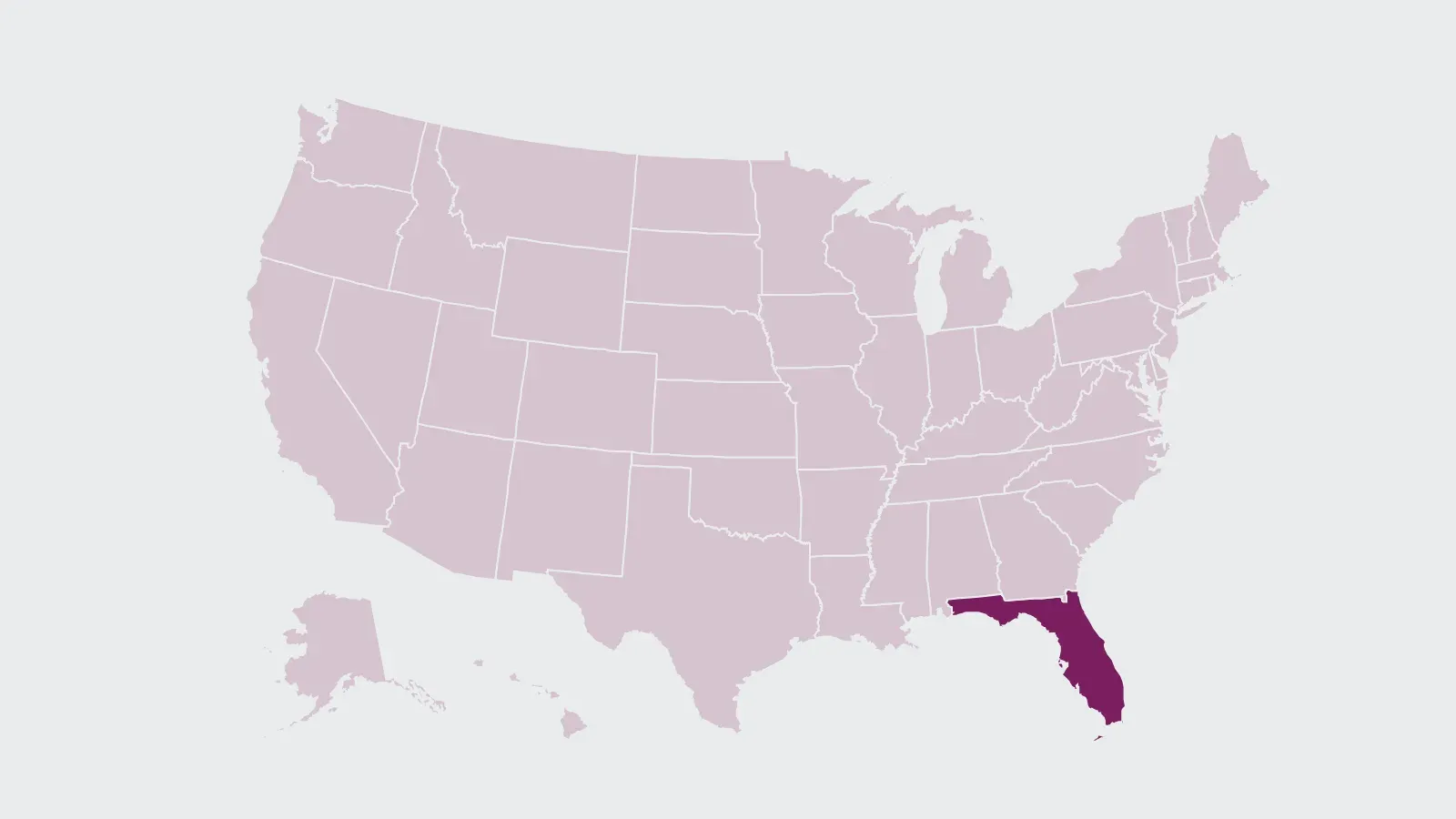
Price tier on the map
$1,500 or more a year
- Minimum liability limits
- $10,000 PIP + $10,000 property damage liability
- No-fault state; bodily injury liability not required for most drivers
- Credit-based insurance scores
- Allowed, not as the only factor
- Fla. Stat. § 626.9741; appeal for divorce, a spouse's death or temporary job loss
- Regulator
- Florida Office of Insurance Regulation
- Consumer complaints go to the Department of Financial Services
Florida's average bill against the nation's
Each year the National Association of Insurance Commissioners (NAIC) reports what insurers collected per insured car in every state. Its latest state data, for 2023, show a Florida average expenditure of $1,864, 19% more than the $1,568 of 2022. Both the level and the one-year jump were the largest of any state or D.C. in that table. The expenditure figure mixes liability-only cars with fully insured ones; a car with all three main coverages averaged $1,994.
| Coverage | Florida | United States |
|---|---|---|
| Liability | $1,294 | $737 |
| Collision | $469 | $464 |
| Comprehensive | $230 | $238 |
| All three (combined premium) | $1,994 | $1,438 |
| Average expenditure | $1,864 | $1,282 |
The table makes the story simple. Collision ($469) is within a few dollars of the U.S. average, and comprehensive ($230) is slightly below it. Liability, at $1,294, is about 76% higher than the national $737 and the highest in the 2023 table. So in Florida the expensive part of the policy is the one that pays for injuries and damage after a crash, not the one that fixes your own car. The NAIC doesn't explain the cause, and your quote will still turn on your record, car and ZIP code; see how your driving record changes the price.
What Florida's no-fault law requires
Florida asks for two coverages before you can register a car with four or more wheels. The Florida Department of Highway Safety and Motor Vehicles (FLHSMV) lists them:
- Personal injury protection (PIP), at least $10,000. It pays 80% of necessary and reasonable medical expenses from a covered injury, no matter who caused the crash.
- Property damage liability (PDL), at least $10,000. It pays for damage you, or someone driving your insured car, cause to other people's property.
- Bodily injury liability isn't part of that basic requirement for most drivers. A driver who has to file an SR-22 to get a license back under the Financial Responsibility Law must certify bodily injury and property damage liability.
The coverage has to stay in force even if the car isn't being driven, and you should turn in the plate before you cancel. A lapse can cost you your license or registration for up to three years plus a reinstatement fee of up to $500. Because so little is required, a minimum Florida policy leaves you exposed if you injure someone, and with about one driver in five uninsured in 2023, by the Insurance Research Council's estimate, uninsured motorist coverage is worth pricing. Our page on limits and deductibles covers how to choose.
How Florida rates get to market
Under section 627.0651 of the Florida Statutes, an insurer has two routes. In a file-and-use filing it submits rates at least 60 days before they take effect, and the Office of Insurance Regulation has 60 days to start disapproval or finish its review, or the rates are deemed approved. In a use-and-file filing the insurer starts charging first and files within 30 days; if the Office later finds the rates excessive, it must order the excess returned to policyholders as a credit or refund.
Insurers may use credit reports and scores, but section 626.9741 bars an adverse decision based only on credit without other underwriting or rating factors. If a divorce, the death of a spouse or a temporary job loss dragged your credit down, you can ask the insurer for an appeal; it must then treat your credit as neutral or leave it out, whichever helps you more. A credit-based decision against you must come with the main reasons, up to four. See credit-based insurance scores.
Coverage when no company will write you
The Florida Automobile Joint Underwriting Association (FAJUA) is the state's market of last resort. It serves licensed drivers and vehicle owners who haven't been able to buy auto insurance from other companies, and every insurer that writes auto coverage in Florida must be a member. You reach it through an insurance agent. Use it as a stopgap and keep shopping as your record improves; our guide to assigned risk plans has the details.
Paying less for Florida coverage
- Drivers 55 and older: take an approved course. State law requires an appropriate premium reduction on liability, PIP and collision for three years after the principal operator completes an approved accident prevention course. The law doesn't fix the amount, and an insurer may require you to stay free of at-fault accidents and moving violations to keep it.
- Compare quotes on the same limits. Since liability is where Florida prices run high, small differences in how each company prices bodily injury and uninsured motorist coverage add up. Match limits and deductibles before you compare.
- Revisit physical damage choices. Collision and comprehensive are close to national averages here; a higher deductible can still lower them, and the deductible break-even calculator tells you how long it takes to come out ahead.
- Ask the state for help. First try to settle a dispute with the insurer. If that fails, the Department of Financial Services takes insurance concerns through its online Consumer Assistance Portal, and lists (850) 413-3089 for insurance assistance, weekdays 8 a.m. to 5 p.m. Eastern.
Questions drivers ask
Why is car insurance so expensive in Florida?
NAIC data for 2023 show the gap is almost all liability: $1,294 in Florida against $737 nationally, while collision and comprehensive were near the U.S. averages. The NAIC doesn't state the causes.
What is the minimum car insurance in Florida?
$10,000 of personal injury protection and $10,000 of property damage liability. Bodily injury liability isn't required for most drivers, though an SR-22 filing requires it.
Do Florida seniors get a discount for a driving course?
Yes. An insured 55 or older who completes an approved accident prevention course gets a premium reduction on liability, PIP and collision for three years. Each insurer sets the amount.
Can a Florida insurer use my credit?
Yes, but not as the only basis for a decision against you, and you can appeal if a divorce, a spouse's death or a temporary job loss hurt your credit. More on credit-based insurance scores.
Where the figures come from
- NAIC — Auto Insurance Database Report 2022/2023 (state average premiums and expenditures)
- Florida Department of Highway Safety and Motor Vehicles — Insurance requirements
- Florida Statutes § 627.0651 — Making and use of rates for motor vehicle insurance
- Florida Statutes § 627.0652 — Safety course discount for insureds 55 and older
- Florida Statutes § 626.9741 — Use of credit reports and credit scores by insurers
- Florida Department of Financial Services — Consumer services
- Florida Automobile Joint Underwriting Association
- Insurance Information Institute — Uninsured motorists (Insurance Research Council estimates)
Facts on this page were checked against these sources on October 26, 2026. NAIC averages are for 2023, the latest year the NAIC has published by state.
Have your rate shopped
Averages can't price your car and your record. Tell us the basics of your policy and Guardbrook passes them to licensed insurance agents and insurers who can quote it; you decide whether to switch.
- 1 Your cars, drivers and current policy.
- 2 How agents can reach you, and your consent.
- 3 A licensed insurance agent or insurer contacts you with quotes. Your policy stays as it is until you decide to switch.
Guardbrook is not an insurance company or agency and doesn't sell, quote or bind policies. You pay Guardbrook nothing; the licensed insurance agents and insurers who contact you set their own prices and terms. How we make money.
Read next
-
Price factor
Driving record
Tickets and at-fault crashes raise prices; OR and MD look back 3 years, CA Good Driver rates are 20%+ lower.
-

Way to save
Defensive driving course discount
At least 10% in Minnesota for drivers 55+, 10% in Delaware at any age. State rules, how long it lasts, how to claim.
-

Shopping guide
Why your premium went up
Market-wide changes vs. your own record. The price index fell 5.0% to September 2026; yours may not have.